túra
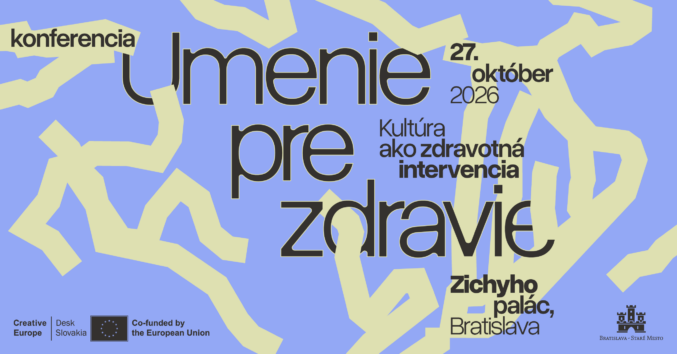
Conference Art for Health: Culture as a Health Intervention
Zichyho palác, Bratislava
Culture and art offer significant benefits for public health. On Tuesday, October 27, in Bratislava, European experts will present findings on the positive effects of culture on health, share specific European experiences with implementing culture as a health intervention—including „art on prescription„—and outline opportunities for cross-sector collaboration in addressing public well-being.
Program:
9:00 Registration and welcome
9:30 Kornelia Kiss, Culture Action Europe (ENG)
10:00 Inga Surgunte, Museums on Prescription Cēsis (ENG)
10:30 Dominika Grygarová, National Institute of Mental Health (CZ)
10:50 Barbora Andor Tóthová, Caring Culture (SK)
11:10 Coffee break
11:30 Panel discussion with the speakers (ENG)
The program will be conducted in English, Czech, and Slovak without interpretation.
Admission is free; advance registration is required.
Time: October 27, 2026, from 9:00 to 12:30
Venue: Music Salon, Zichy Palace, Ventúrska 9, Bratislava
The event is organized by the Creative Europe Desk Slovakia in cooperation with the Bratislava-Old Town district.
Kornelia Kiss is a Head of Culture and Health at Culture Action Europe (CAE),the major European cross-cultural network. She is the co-author of the ’CultureForHealth Report”, advised on the EU’s Culture and Health: Time to Act report and advocates for this topic on a European level. She established the EU-funded CultureAndHealth Platform that supports artists at the interprofessional space of culture, health and wellbeing with 17 partner organisations in 15 countries and leads the policy work of the EU-funded European Culture and Health Hub Horizon project.
From Evidence to Policy in Culture and Health Mental health is regarded as the one of the biggest health challenges of our times and the feeling of loneliness is soaring in our societies. There is now substantial evidence on how cultural activities contribute to better health and wellbeing- supporting prevention, management and treatment of disease as well as community well-being. If we know it is working, what prevents us from moving from project -by project implementation to a true policy change? How can we build bridges across culture and health sectors? How is the EU trying to help this process and what is happening in Member States?
Inga Surgunte is a Research Assistant at the Culture and Arts Institute of the Latvian Academy of Culture and is involved in several international projects exploring the impact of culture and arts on health and well-being, both at individual and community level. From 2021 to 2023 Inga collaborated with the Eduards Veidenbaums Museum „Kalāči“ to develop Latvia’s first permanent exhibition and educational program focused on mental health. In 2023, she co-authored the guide Talking Points: Arts and Health in Communities with Diana Walters. Currently, Inga leads the Museums on Prescription programme in Cēsis Municipality, which supports wellbeing and strengthens social connections within local communities through referral-based cultural programmes. Inga has also contributed to the European Commission preparatory action CultureForHealth, which played a key role in the inclusion of „culture and health“ priority in the EU Work Plan for Culture 2023-2026. From 2024 to 2025, she represented the Ministry of Culture of the Republic of Latvia in the European Commission’s Open Method of Coordination (OMC) group on Culture and Health. From 2024 to 2026 she has been developer and lecturer of the microqualification course Culture and Health: Managing Cross-Sector Initiatives, jointly developed by four Baltic universities within the EU-funded WITAC project. In 2025, she co-founded the Association Culture and Health Latvia and serves as its first Chairwoman.
Arts on Prescription. The Baltic Model From 2023 to 2025, 13 partners from countries around the Baltic Sea joined forces to adapt the successful and globally recognized UK-born Social Prescribing model to this region. Supported by Interreg, the project focused on one part of Social Prescribing – Arts on Prescription (AoP). The aim was to tailor and test the model, and to develop a Guide based on this experience for policy makers, AoP project managers, link workers, and facilitators of the AoP activities. Inga Surgunte represented Cēsis Municipality in Latvia and led a team that actively contributed to the adaptation, testing, and Guide creation. In her presentation, Inga will share the project results, highlighting the Cēsis pilot initiative “Museums on Prescription,” which established cooperation between local health, social institutions, and museums to promote residents’ well-being. The programme continues to be implemented by the municipality and, from 2026, is entering a new phase of development and expansion.
Dominika Grygarová, Ph.D., works as a researcher at the Centre for Advanced Studies of Brain and Consciousness at the National Institute of Mental Health (NUDZ) in Czechia. Her doctoral thesis focused on linking research into the subjective experience of art with methods from neuroscience and neurophenomenology. At NUDZ, she specializes in the cognitive neuroscience of art and media, utilizing eye-tracking and neuroimaging methods. She is a co-founder of the National Platform for Prevention through Culture, an initiative connecting NUDZ with arts and cultural institutions to systematically develop and implement a model for mental health prevention through cultural and artistic activities.
Culture as a Prevention Tool: The Establishment of the National Platform for Prevention through Culture This presentation introduces the emerging National Platform for Prevention through Culture, currently being developed at the Czech National Institute of Mental Health in collaboration with arts and cultural institutions. It focuses on the platform’s underlying principles and the conceptualization of culture and cultural participation as vital components of the public and mental health infrastructure in the Czech Republic. The presentation outlines the platform’s proposed structure and operational model, including its six main programmatic pillars. It also details planned collaboration mechanisms among cultural institutions, experts, and the research community; opportunities for sharing experiences and best practices; publishing and information activities; and the basic funding framework. Attention will also be devoted to developing specific forms of prevention based on art and active participation in culture.
Barbora Andor Tóthová is a cultural manager, researcher, and co-founder of Kino Úsmev. Since 2013, she has been involved with the civic association CINEFIL, organizing community screenings and festivals in Košice. In 2016, CINEFIL succeeded in reviving the last remaining abandoned cinema in the city center—Kino Úsmev. Since then, Barbora has overseen various stages of its operation and redevelopment, gaining over 10 years of experience as a cultural manager and exhibitor. In 2019, Barbora launched Kino Úsmev’s unique inclusive film program formats, and since 2021, she has been running the Inclusive Film Festival and Inclusive Summer Camp. She holds PhD in Regional Economics, focusing on grassroots cultural centers, their innovations, and their impact on urban environments. As a researcher and facilitator, she is dedicated to the cultural and creative industries, grassroots cultural initiatives, cultural ecologies, and cultural policy. The concept of care and the intrinsic value of arts and culture lie at the center of her attention. In 2024, she became a Creative Impact Research Center Europe Fellow. She founded her own research and policy platform, Caring Culture in 2024 and co-created Caring Cinema platform in 2025.
Caring Culture What happens if we begin to view culture as part of the essential infrastructure vital to life? Much like healthcare or education, culture and cultural organizations provide care, healing, and education. What is missing in Slovakia for culture to be recognized as a fundamental element in building strong, sustainable communities and localities? How does the community work at Kino Úsmev address these needs? Barbora will present the findings of her research and a case study on community care at Kino Úsmev.